Writing
These days most of my writing is about one idea: the quantitative tools Wall Street uses to measure performance and risk shouldn't be reserved for Wall Street. Further down are older essays on learning, focus, and how people think, from my PhD years and earlier.
The book
Improving Performance and Risk: An Actionable Guide For the Rest of Us
A brief, non-math guide to Wall Street quantitative techniques.
Most investors judge an investment by one number: how much it went up. Professionals look at performance and risk together, and size their positions accordingly. This guide explains those ideas in plain language, with charts and real examples from stocks, indexes, gold, and crypto, and without requiring any math.
You don't need to understand how an engine works to drive a car. In the same way, you don't need statistics to benefit from what quantitative finance has learned.
"To democratize Wall Street investment technology for mainstream investors and make it super-affordable, so that all mainstream investors can benefit, not just Wall Street professionals."
What it covers
Part A (published December 2018):
- The power of quantitative finance for your investments
- What performance and returns really mean
- Understanding and measuring risk
- An intuitive way of looking at volatility
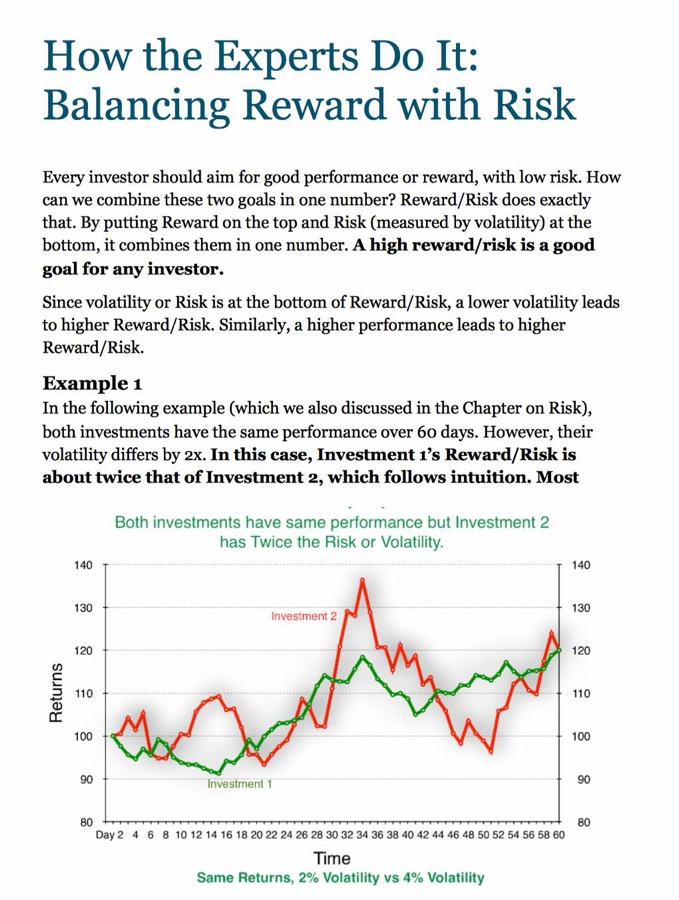
- How the experts do it: balancing reward with risk
- Putting it all together
Part B (in progress):
- Crash and tail risk
- Correlation, diversification, and hedging
- Risk-balanced allocation
- Trends and momentum
- Comparative intelligence: judging investments relative to each other
From book to tools
The ideas in the book now live in free, interactive form in EasyCompare and BetterThanSPY, part of my quantitative investing initiative. Instead of static tables from 2018, you can see reward versus risk, volatility, and drawdowns for any stock or ETF, updated daily.
Essays, 2007 – 2009
From Diary of a Wannabe Intellectual, the blog I kept during and just after my PhD. Mostly about psychology, productivity, learning to swim as an adult, and what I was noticing after moving into finance.
2009
- May 17Creating your own challenges
- May 11Why can't we concentrate?
- May 10Cursing the rain: a signal ?
2008
- Oct 12Should academicians and scientists do finance ? A reply
- Oct 11Living life like a call option
- Aug 17Is career planning really time wasted ?
- Jul 14Antoine de Saint Exupery’s depth of human understanding
- Feb 5How to be a genius .. hmmm
- Feb 1Another benefit of intense training
2007
- Aug 21The death of intellectual curiosity with age ?
- Jul 31Being a people pleaser vs based on values
- Jul 29Today’s swimming class: treading, freestyle
- Jul 29Some amazing freestyle swimming videos
- Jul 29Panel member on joining Graduate school for undergraduates
- Jul 27More tips on swimming: Breathing for freestyle
- Jul 22Beginning to swim: Drag and Balance
- Jul 19Nice guys don’t finish second
- Jul 18Swimming as a fitness lifestyle
- Jul 17Phrase for Procrastination: Do it imperfectly
- Jul 17Art of Effortless Concentration
- Jul 16Dualism vs becoming the mind
- Jul 15A diary of a wannabe intellectual
Undergraduate essays
-
A Vedic solution to the scarcity of natural resources
Looks at the Vedic basis of living, the primary cause of food scarcity and environmental strain, and what the Vedas propose to overcome it. Written for a technical communication course at IIT Delhi.
-
The psychology of criminals
Is society responsible for the behavior of criminals? A report and presentation on criminal psychology, for a humanities course at IIT Delhi.
-
Technology and culture
A report for a humanities course on technology and culture at IIT Delhi, 1999.